 Skip to content
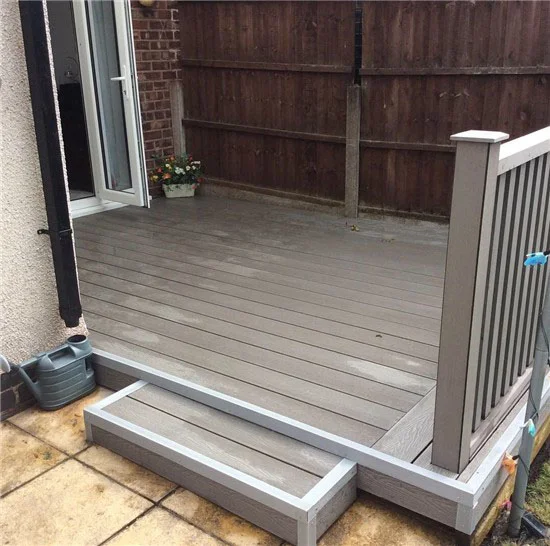
If you’re planning a garden upgrade this year, you’ve probably landed on the same question most homeowners bring to us at Sale Driveways and Patios. Should you go for decking or a patio? Both give you a solid, usable outdoor space, both look great in the right setting, and both come up again and again when people ask what actually adds value to a home.
The honest answer is that both can add value. But they add it in different ways, and the right choice depends on more than what looks nice in photos. We fit both, from simple gravel patios to fully raised composite decks, as part of our patios and decking service, so here’s what we tell customers once they ask us to compare the two.
The quick answer
Patios tend to edge ahead of decking when it comes to added value. That’s mainly because they’re seen as more permanent and need far less upkeep over the years. Decking is usually cheaper to install and works better in gardens that slope or have awkward levels. Neither is the wrong choice. It just depends on your garden, your budget, and how much maintenance you’re willing to take on.
What each option costs to install
Prices vary depending on material, but as a general guide for 2026:
- Patios typically run from around £65 to £160 per square metre, fully installed. Concrete slabs sit at the cheaper end, while natural stone and porcelain paving push towards the top.
- Softwood decking usually costs around £70 to £90 per square metre installed, making it one of the cheapest options upfront.
- Composite decking comes in higher, roughly £90 to £110 per square metre, but needs far less looking after.
- Hardwood decking is the most expensive of the three, often £110 to £130 per square metre or more.
For an average garden project of around 20 square metres, you’re typically looking at a few thousand pounds either way. Material choice can easily double that figure, so it’s worth deciding on quality first and working the budget around it, rather than the other way round.
How long each one actually lasts
This is where the real cost difference shows up, and it rarely gets mentioned in the initial quote.
A well laid stone or porcelain patio can last 30 to 50 years with only basic care. Block paving typically lasts 20 to 30 years. Timber decking, even when properly maintained, usually needs replacing after 10 to 15 years. Composite decking does much better, often lasting 25 years or more thanks to its resistance to rot and UV damage.
Once you spread the cost across the lifespan, a patio or composite deck almost always works out cheaper per year of use than timber decking, even though timber costs less to install in the first place.
Maintenance: what you’re really signing up for
A patio needs an occasional pressure wash and, if it’s natural stone, resealing every couple of years to stop it staining. That’s more or less the whole job.
Timber decking asks for a lot more. It needs cleaning and treating with oil or stain every one to two years to stop it rotting, and Manchester’s wet climate doesn’t do it any favours. Skip a year of treatment and you’ll notice algae building up fast, followed eventually by soft or spongy boards that need replacing.
Composite decking sits somewhere in between. It still needs the odd wash to stop algae taking hold in the grain, but nothing close to the annual commitment that timber demands.
Which one actually adds more value
Various UK property studies put the value uplift from a new patio or new decking somewhere in the region of 3 to 5 percent, and on an average priced home that can add several thousand pounds at resale. The real difference is in how buyers and estate agents perceive the two.
A well built stone or porcelain patio reads as a permanent improvement, something that will still look sharp in fifteen years. Ageing or poorly maintained timber decking, on the other hand, is often flagged by buyers and surveyors as a maintenance job waiting to happen rather than a finished feature. So if resale value is the main driver, a quality patio, or composite decking built to last, is usually the safer bet.
Practical factors that matter more than the marketing
- Slope and levels. If your garden isn’t flat, decking is often the more cost effective choice. Levelling ground for a patio can mean extensive excavation or retaining walls, while a deck can simply be built on a raised frame.
- Drainage. Patios need a proper sub-base and fall to stop water pooling. Decking drains naturally through the gaps between boards, which is handy in a wet climate, but the space underneath still needs airflow to stop damp building up.
- Heavy furniture or a hot tub. A patio on a solid base gives you rock steady support without a second thought. If you want the same on decking, check the joist spacing and load rating carefully, since not every deck is built to take that kind of weight.
- Style. Patios suit a traditional look and pair well with older homes. Decking tends to feel more contemporary and works well for raised or split level gardens.
A quick word on planning permission for decking
Most ground level decking in England falls under permitted development and doesn’t need planning permission, provided it stays under 30cm in height, doesn’t cover more than half your garden once combined with other structures like sheds, and isn’t built in front of the house. Go higher than 60cm and building regulations will also require a proper handrail or balustrade for safety. If your home sits in a conservation area or is a listed building, the rules tighten considerably, so it’s always worth a quick check with your local council before you start digging.
Patios rarely run into the same issue. A ground level patio in a back garden is generally straightforward from a planning point of view, though it’s still sensible to check if you’re building close to a boundary or raising the level significantly.
So which should you choose?
Go with a patio if your garden is reasonably flat, you want the lowest possible maintenance, and you’re planning to stay in the house long enough to appreciate not re-treating decking every other spring.
Go with decking if your garden slopes or has awkward levels, you want a raised, contemporary look, or a lower upfront cost matters more to you than yearly upkeep, especially if you choose composite.
Do both if your garden is big enough. Plenty of homes get the best of both worlds with a patio dining area close to the house and a deck making use of an awkward corner or level change further down the garden. It’s worth planning the rest of the space at the same time too. Our garden services team can tie the planting, borders and pathways in with the hard landscaping, so the whole garden works as one design rather than two separate projects bolted together.
The bottom line
Whichever way you lean, the biggest factor in how much value either option adds isn’t really the material. It’s the quality of the groundwork underneath it. A patio laid on a poor sub-base will crack and sink within a few years. Decking built without proper ventilation will rot faster than any UK weather report could predict.
If you’re weighing up decking against a patio for your own garden, we’re happy to talk through what will work best for your space and budget. Get in touch for a free, no-obligation quote.
