
Driveway drainage problems happen when rainwater cannot run off or soak away from your drive quickly enough, leaving puddles that linger, spread or creep towards your house. Having built and repaired driveways in Sale and the surrounding areas, we see the same handful of causes come up again and again, and most of them can be put right once you know what you are looking at.
In a part of the country as wet as Greater Manchester, a drive that drains badly soon becomes a slip hazard in winter, a home for moss in summer and, over time, a source of expensive repairs. This guide explains what causes standing water, how to tell if your driveway is not draining properly and the practical ways to fix driveway puddles.
In this guide:
- What causes standing water on driveway surfaces
- Signs your driveway is not draining
- How to fix driveway puddles
- Planning permission and drainage
- When to call a professional
What Causes Standing Water on Driveway Surfaces?
Standing water on driveway surfaces is rainwater that stays put for hours or days after the rain has stopped, usually because the drive has the wrong fall, a sunken patch or a blocked outlet. In most cases, more than one of the causes below is at work.
Wrong fall or gradient
Every driveway needs a gentle slope so water runs towards a drain, border or the road rather than back towards the house. A fall of around 1:60 to 1:80 is a common guide. Drives laid dead flat, or sloping the wrong way, tend to hold water from the first heavy shower.
Sunken or settled areas
If the ground was not dug out deeply enough, or the sub-base was not compacted properly, parts of the drive can sink under the weight of cars. These shallow dips collect water, and the surface above them often begins to crack, rut or rock underfoot.
Blocked drains and gullies
Channel drains and gullies slowly fill with leaves, grit and silt. Once the grates or pipes are clogged, water has nowhere to go and backs up across the surface.
Impermeable surfaces with no outlet
Standard tarmac, concrete and traditional block paving shed water rather than absorb it. That is fine when the water is directed to a drain or soft ground, but if the low point is hemmed in by walls or kerbs, it pools.
Heavy clay ground
Large parts of Greater Manchester sit on clay, which drains slowly. Soakaways and permeable surfaces still work on clay, but they need to be designed for it, with enough sub-base depth to hold water while it soaks away.
Downpipes and clogged joints
A downpipe emptying straight onto the drive concentrates water from a whole section of roof in one spot. On permeable paving and resin bound drives, moss, weeds and fine dirt can also gradually seal the joints or open texture that water is meant to pass through.
Driveway Not Draining After Rain? Check These Signs
A driveway not draining properly is one where water lingers, spreads or flows the wrong way after rain instead of clearing shortly after the shower stops. Walk your drive the morning after heavy rain and look for:
- Puddles that are still there the next day
- Green algae or moss growing in the same patches
- Dried lines of silt or dirt marking where water has sat
- Blocks that rock, sink or have lost their jointing sand
- Water running towards the house, garage door or threshold
- Ice forming in the same places every winter
Water reaching the house deserves quick attention. Paving is generally recommended to sit at least 150mm below the damp proof course, and when a drive is too high or falls towards the walls, rainwater can splash or soak above it and raise the risk of damp.
How to Fix Driveway Puddles for Good
To fix driveway puddles, you need to give rainwater a clear route off or through the surface, either by removing whatever is blocking it, correcting the levels or adding new drainage. Start with the simple checks before paying for bigger work.
Clear and maintain what you already have
Lift drain grates, scoop out debris and flush the channels with a hose. Clear moss and weeds from joints, then brush kiln-dried sand back into block paving joints so the blocks stay locked together. If a downpipe empties onto the drive, divert it into a water butt, a border or a properly sized soakaway.
Lift and relay sunken sections
Where puddles sit in isolated dips, the surface can often be repaired locally. On a block paving driveway, the affected blocks are lifted, the bedding layer is relevelled and the blocks are relaid to match the surrounding fall. Dips in tarmac usually need cutting out and patching or overlaying.
Install a channel drain
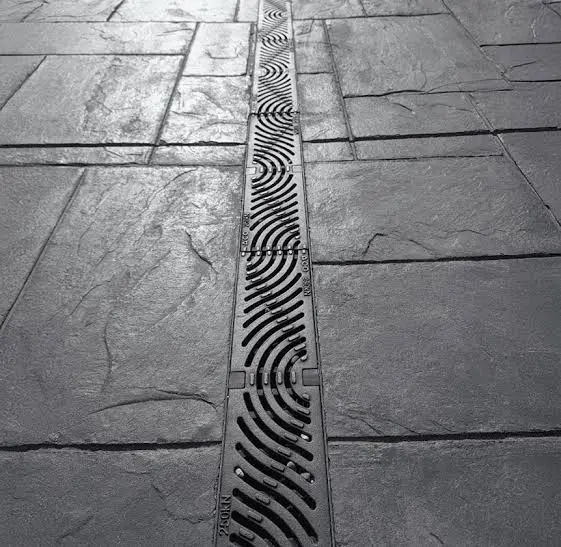
A linear channel drain laid across the low point of the drive, or in front of the garage, catches surface water before it spreads. It needs somewhere suitable to discharge, such as a soakaway, a rain garden or a permeable border. Connecting to a public sewer requires approval from your water company.
Switch to a permeable surface
When the whole drive is flat or impermeable, resurfacing is often the only lasting answer. Permeable block paving, resin bound surfacing laid on a porous base and stabilised gravel driveways all let rain soak through rather than run off.
Rebuild when the base has failed
Widespread sinking, cracking and puddling usually point to a failed sub-base. Resurfacing over it only hides the problem for a while, so the lasting fix is to excavate, rebuild the base and relay the surface with the correct fall.
Do You Need Planning Permission for a New Drive?
In England, you only need planning permission to pave a front garden if the area is over five square metres and uses an impermeable surface that sends rainwater nowhere permeable. The rule has applied since October 2008 to help reduce surface water flooding.
You do not need permission for a new or replacement driveway of any size if it uses permeable materials, such as gravel, permeable block paving or porous asphalt, or if rainwater is directed to a lawn or border to drain naturally. Different rules can apply in conservation areas and for listed buildings, so check with your local council if either applies to your home.
When to Call a Driveway Professional
You should call a professional when puddles cover a large area, keep coming back after cleaning, or appear alongside sinking, cracking or water near the house. These are signs the problem sits below the surface, in the levels or the sub-base.
A proper survey checks the falls, the condition of the base, the ground type and where water can be discharged, so any repair deals with the cause rather than the symptom. If you are in Sale, Altrincham, Timperley or nearby, you can book a free driveway site survey and get clear advice on whether a repair, new drainage or a full rebuild makes most sense.
Driveway Drainage FAQs
How long should water sit on a driveway after rain?
On a well-built drive, surface water should clear soon after the rain stops. Puddles still there the next day usually point to a fall, base or drainage fault.
Can I fix driveway puddles myself?
Small issues, such as blocked grates, moss-filled joints or a downpipe emptying onto the drive, are usually manageable yourself. Dips, sinking and wrong falls need the surface lifting and relevelling, which is best left to an experienced installer.
Is a resin driveway good for drainage?
Resin bound surfacing is porous, so water drains through it when it is laid on a permeable base. Resin bonded surfacing, where stones are scattered onto a resin coat, is not permeable, so it is worth checking which type you are being quoted for.
Can standing water damage a driveway?
Yes. Water that sits on a drive can wash out jointing sand, encourage moss and algae and, in freezing weather, expand in cracks and open them further. Over time, this shortens the life of the surface.