
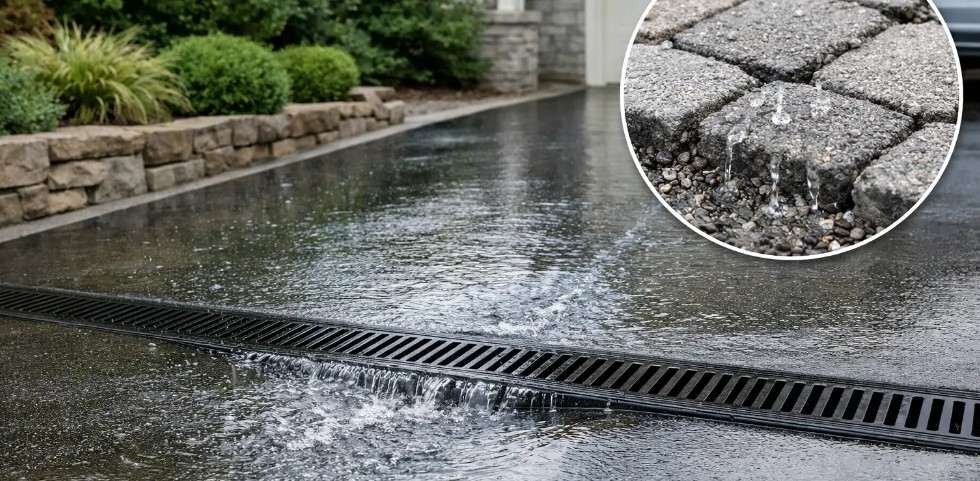
A SuDS compliant driveway is a driveway that deals with rainwater on your own land instead of sending it onto the pavement, the road or the public sewer. In England you can lay one at any size without planning permission, provided the surface is permeable or the water runs off to a lawn, border or soakaway inside your boundary. That rule has been in force since 1 October 2008. Here is what the law says in 2026, which surfaces qualify and what to check first. Our team handles driveway installation in Sale and will talk drainage through at survey.
What is a SuDS compliant driveway?
A SuDS compliant driveway is one built to sustainable drainage principles, meaning rainfall is absorbed, slowed or stored close to where it lands rather than piped away at speed. A sealed driveway turns rain into instant runoff, and thousands of sealed front gardens in one catchment overwhelm drains never sized for them.
National guidance sets a fixed order for where surface water should go: reuse, then infiltration into the ground, then a watercourse, then a surface water sewer, with a combined sewer as the last resort. For a domestic driveway that means infiltration, through the surface itself or into a soakaway. Cost is not a reason to skip down the list.
Driveway drainage rules UK homeowners must follow
Driveway drainage rules in the UK require surface water from a new or replacement driveway to be managed within the property rather than discharged onto the public highway. In England the trigger is area and material: lay more than five square metres of impermeable surfacing in your front garden without directing the water to a permeable area and you need planning permission.
Five square metres is roughly one parking bay, so most driveways clear it. The rule covers the land between the front wall of the house and the highway. Repairs under that threshold are fine in any material. Runoff crossing the pavement is never acceptable, whatever the size.
Wales works to the same principle and adds a statutory SuDS Approving Body, running since 2019, so larger schemes need separate SAB sign off before groundworks. Scotland and Northern Ireland have their own positions, and the local planning authority is the place to confirm them.
Councils can enforce, and an unpermitted driveway routinely surfaces during conveyancing, leaving you applying retrospectively with a buyer waiting.
Permeable driveway UK options that comply
A permeable driveway is one where the surface and the layers beneath it let rainwater pass into the ground rather than shedding it sideways. Several finishes qualify, and all stay within permitted development at any size.
- Permeable block paving, with wider joints filled with clean grit so water drains between the blocks. See our permeable block paving driveways for the finishes we install.
- Resin bound, which is porous by nature when it sits on a permeable base. Resin bonded is not the same product and does not drain, so check which you are quoted for on resin bound driveways.
- Gravel, the cheapest compliant option, and porous asphalt for a sealed look that still drains, both covered under gravel and tarmac driveways.
- Wheel tracks, where two paved strips carry the car and the ground between stays planted or gravelled.
One point decides whether any of this works: permeability comes from the whole build-up, not the top layer. A permeable block over compacted MOT Type 1 is a sealed driveway with an expensive surface on it, because Type 1 contains fines that lock together and stop water moving. Compliant builds use open graded angular stone, typically 4 to 20 millimetre clean, over a geotextile. Ask your installer to state the sub-base on the quote.
Driveway soakaway rules and when you need one
Driveway soakaway rules govern where a soakaway can be placed and how big it has to be, so that infiltrated water disperses safely instead of undermining foundations. A soakaway is a buried void, usually plastic crates or clean stone, that holds runoff and releases it slowly into the subsoil.
- Keep it at least 5 metres from any building and 2.5 metres from a boundary, per Approved Document H.
- Test the ground first. A percolation test to BRE Digest 365 gives the infiltration rate, and nothing can be sized without it.
- On free draining ground, allow roughly 1 cubic metre of storage per 50 square metres of hard surface as a starting figure only.
- Keep the base of the soakaway at least 1 metre above the highest seasonal water table.
Heavy clay usually fails the test outright, which matters around Greater Manchester where clay subsoils are common. Where infiltration is not viable, use a lined attenuation tank that stores runoff and releases it at a controlled rate. Soakaways are also ruled out in high flood risk areas and groundwater source protection zones.
Sustainable drainage driveway cost and upkeep
A sustainable drainage driveway costs more to build than a sealed one, mainly because of deeper excavation and a dearer stone specification, and it needs its joints kept clear to keep working.
Set against that, there is no planning application, no fee and no wait. Maintenance is light but not optional. Silt is what kills permeable paving: soil, leaf litter and washed in sand clog the joints until water sits on top. Brush or vacuum the joints once or twice a year, top the grit up when it drops, and never store soil or sand on the driveway.
Do you need planning permission in 2026?
You do not need planning permission for a driveway in England if the surface is permeable or the runoff drains to a permeable area within your own garden, whatever its size. You do need it for more than five square metres of impermeable surfacing that sheds water off site.
Three things change that answer. Flats and maisonettes sit outside these householder rights. Listed buildings and conservation areas carry extra consents. An Article 4 direction can remove permitted development rights on a given street, so call the planning department either way.
Dropping the kerb is separate. That is a highways matter and needs the council’s approval whatever surface you choose.
One myth is worth killing. Several articles published this year claim mandatory SuDS approval arrived in England in 2026 under Schedule 3 of the Flood and Water Management Act 2010. It did not. Schedule 3 remains uncommenced in England, there is no SuDS Approving Body here, and sustainable drainage is delivered through the planning system.
Is a resin bound driveway SuDS compliant?
Yes, when laid over a permeable sub-base. Resin bound is porous in itself, but only drains if the layers beneath it drain too. Resin bonded is a different product and is not permeable.
Can I keep my existing concrete driveway?
Yes. The rules apply to new and replacement surfaces, not to what is already down. Repairs under five square metres are exempt. A full replacement has to comply.
Do I need permission to install a driveway soakaway?
Not usually, for a householder driveway. It must still meet the siting distances in Approved Document H and must not push water towards a neighbour’s property.
How much does a permeable driveway cost in the UK?
It varies with size, ground conditions and finish. Expect a premium over a sealed build for the deeper excavation and stone. Ask for the sub-base specification before comparing quotes.
Get your driveway drainage right first time
Drainage is decided before the first digger arrives. To get the build-up specified for your ground, book a free driveway site survey and we will assess the ground and set out your compliant options.