
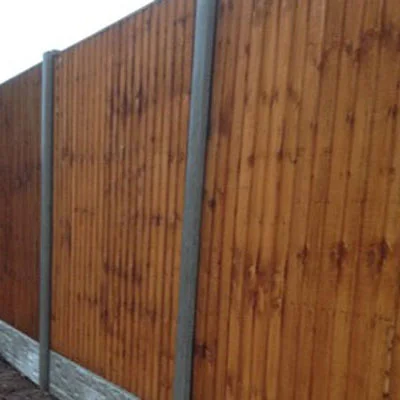
In most cases you can build a fence up to 2 metres high without planning permission. If the fence sits next to a road, pavement or public footpath, the limit drops to 1 metre. Anything taller needs permission from your local council. Our fencing and walls covers the height check as part of the free survey, so you know where you stand before anything gets built.
It sounds simple enough, but this is one of those rules where the detail catches people out. Plenty of homeowners have put up a perfectly reasonable looking fence, only to get a letter from the council a few months later. Here is what actually applies.
What Height Am I Allowed?
| Where the fence goes | Maximum height without permission |
|---|---|
| Rear or side garden, not facing a road | 2 m |
| Boundary next to a road or pavement | 1 m |
| Boundary next to a public footpath beside a road | 1 m |
| Front garden facing the street | 1 m |
| Between you and a neighbour, away from any highway | 2 m |
These are the permitted development limits for England and Wales. Scotland and Northern Ireland work slightly differently, so check locally if you are outside England and Wales.
What Counts as “Next to a Highway”?
This is where most people get tripped up. A highway does not just mean a busy road. In planning terms it covers the pavement, the verge, and any public footpath running alongside a road used by vehicles.
So if your front garden fence runs along the pavement, you are limited to 1 metre. Not 2. The same applies to a side boundary on a corner plot where one side faces the street, which is why corner houses so often end up with a lower fence down one side.
A private path or an alleyway that is not a public right of way is different, and the 2 metre limit usually applies there. If you are not sure which category yours falls into, the council can tell you in a phone call and it is worth the five minutes.
Does Trellis Count Towards the Height?
Yes. This is the single most common misunderstanding in garden fencing.
There is a widely repeated belief that you can put a 2 metre fence up and then add trellis on top for extra privacy, because trellis somehow does not count. It does. Planning rules measure the total height of the structure, including any trellis, lattice or decorative topper.
A 1.8 m fence with 30 cm of trellis is a 2.1 m structure, and that puts you over the limit. If you want the height, you need permission for it, regardless of whether the top section is solid or not.
How Is Height Measured If My Garden Slopes?
Fence height is measured from ground level, and where the ground on each side sits at different heights, it is generally taken from the higher side.
This matters more than you would think on Manchester properties, where plenty of gardens step up or down from the neighbouring plot. If your garden sits half a metre lower than next door, a fence that looks 2 m from your side may already be over the limit when measured from theirs.
The same principle applies if you are putting a fence on top of a wall. The two are treated as one structure, so a 600 mm retaining wall with a 1.8 m fence above it is a 2.4 m structure and will need permission.
When Do I Actually Need Planning Permission?
You need to apply if any of the following apply to your project:
- The fence will be over 2 m anywhere on the property
- The fence will be over 1 m where it borders a road, pavement or public footpath
- Your property is listed, in which case you need listed building consent for any boundary work
- Your permitted development rights have been removed, which is common on newer estates
- An Article 4 direction is in place, which some conservation areas use
That fifth point catches a lot of people on new build estates. Developers frequently attach planning conditions or restrictive covenants that limit boundary treatments, and those override the standard permitted development allowances. Check your deeds before you order materials.
An application for a fence is usually a householder application and the fee is modest compared to the cost of taking a fence down and rebuilding it.
Whose Fence Is It Anyway?
Before you touch a boundary, work out whose it is. Your title deeds or your Land Registry plan will normally show T marks along the boundaries. A T mark pointing into your plot means that boundary is your responsibility. A double T, sometimes called an H mark, means it is shared.
Worth knowing: in most cases there is no legal obligation to put up a fence at all. Unless your deeds specifically require it, nobody can force you to fence a boundary, and equally you cannot force a neighbour to replace theirs.
Can I Attach Anything to My Neighbour’s Fence?
Not without asking. If the fence belongs to next door, hanging planters, lights, trellis or climbing plant supports on it counts as interfering with their property, even if it seems harmless.
The usual solution when you want your own arrangement is to put up a second fence just inside your own boundary. It costs more, but it removes the argument entirely and you can do what you like with it.
What Happens If My Fence Is Too High?
The council can serve an enforcement notice requiring you to reduce it or take it down. In practice this almost always starts with a complaint, usually from a neighbour whose light or view has changed.
You can apply for retrospective permission, and it is sometimes granted, but you are negotiating from a weak position and there is no guarantee. Taking down and rebuilding a fence you have just paid for is an expensive way to learn the rule, which is why a five minute check beforehand is time well spent.
If the issue is a fast growing evergreen hedge rather than a fence, that falls under separate high hedge rules and the council handles it through a different process.
Common Questions
Can my neighbour make me lower my fence? Not directly. They can complain to the council, and if the fence breaches the rules the council can act. If it is within the limits, there is nothing they can do about the height alone.
Do I need permission to replace an existing fence? No, provided the new one is the same height or lower and stays within the permitted limits. Like for like replacement is fine.
Is 6 ft the same as 2 metres? Close but not identical. Six feet is roughly 1.83 m, so a standard 6 ft panel sits comfortably under the limit. Add a gravel board underneath and you are at about 1.98 m, which is still legal but leaves almost no room for anything on top.
Do the rules apply to garden walls too? Yes. Walls, gates and fences are all treated the same way for height purposes.
Get It Right First Time
Every boundary is slightly different, and the only way to be certain is to have someone look at the ground levels, the deeds and the position relative to the road. We check all of that before quoting, so you never end up paying twice.
Sale Driveways and Patios installs fencing, gates and garden walls across Sale, Altrincham, Timperley, Urmston, Irlam and Cadishead. You can see the full range of what we do on the Sale Driveways and Patios, and if the project involves reshaping the garden around the new boundary, our garden services team can handle that at the same time.